

What Rosary Beads Really Are in Daily Life
When people talk about rosaries, it is easy to think just about the prayers or the structure of the decades. But in daily life, the physical beads themselves play a very down-to-earth role. They sit in a pocket, rest on a nightstand, hang from a rearview mirror, or wait in a small pouch in a work bag. They are there when you cannot find the right words and need a simple way to stay with God for a few quiet minutes.
My own Rosary Beads Guide, if I had to summarize it in one sentence, would be this: choose beads that you will actually reach for. That means paying more attention to how they feel in your fingers, how sturdy they are for real life, and how they fit your daily routine, rather than worrying about how they look to others.
How Rosary Beads Support a Quiet Heart
Rosary beads are not magic objects and they do not guarantee any particular outcome. But they do offer structure. When life feels scattered and noisy, just having a familiar chain of beads in your hand can bring a sense of steady rhythm. The repeated movement from bead to bead can help calm racing thoughts, not by forcing them away, but by giving your mind something simple and steady to hold onto.
For me, this has mattered most on nights when sleep is hard to find. I will lie in bed and quietly slip my fingers from bead to bead, sometimes not even finishing a full rosary. The act itself reminds me that I am not alone. Over time, those small, hidden moments with the beads have become part of my personal Rosary Beads Guide—less about “finishing” and more about simply being with God for as long as I can.
Materials: Wood, Metal, Glass, and More
One of the first choices people face is material. Different materials bring different feelings and practical benefits, and none of them are inherently “better” for prayer. The right one is the one that you will naturally hold and use.
Wooden Rosary Beads
Wooden rosaries are often light and warm to the touch. They usually feel gentle in the fingers and can be especially good for long times of prayer because they do not feel cold. A simple wooden rosary can slip easily into a pocket without adding weight. Many people appreciate that wood can pick up a soft polish over the years from being held and prayed with often.
I still remember my first wooden rosary. It was a simple brown cord rosary that someone left in a basket at the back of church. The beads were not perfectly smooth, and a few had small marks in them. Somehow, that made it easier for me to pray. It reminded me that prayer with the rosary is not about perfection but about coming honestly, just as we are.
Metal and Chain Rosaries
Metal rosaries, especially those with chain links, can feel a bit more formal and traditional. The weight in the hand can be grounding. Some people like the gentle clicking sound when the beads move. Metal chains can tangle if they are thin, so sturdier links can be helpful for everyday use.
If you keep a rosary in a bag or purse, a chain rosary can be a solid choice when it is well-made, because the metal can handle being bumped around a bit. Many classic family rosaries that are passed down are metal, and just holding them can connect us to those who prayed before us.
Glass, Crystal, and Decorative Beads
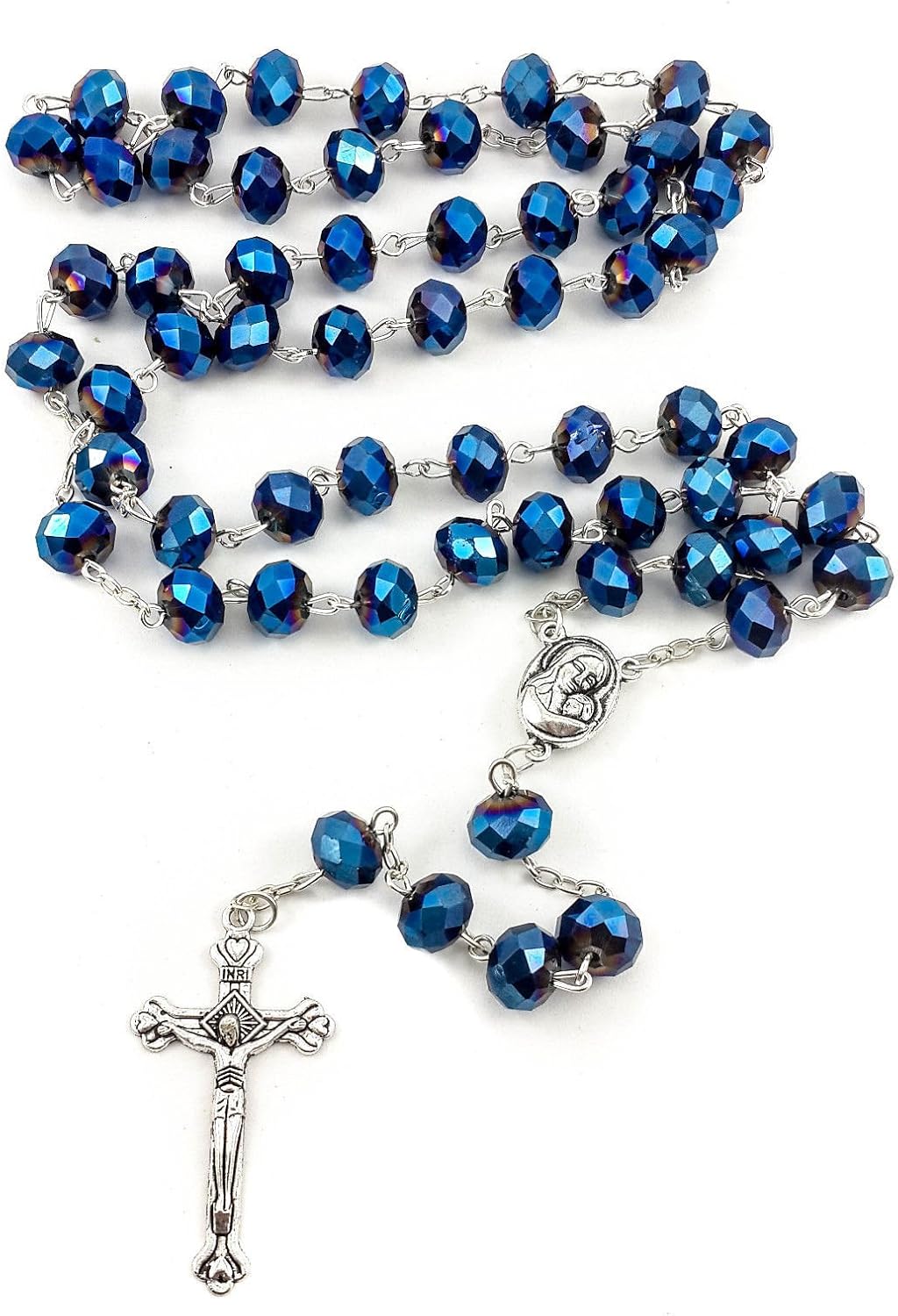
Glass and crystal rosaries can be beautiful, catching light in a way that naturally draws the eye. They may feel cool at first touch and gradually warm in the hand. These can be meaningful gifts for special occasions like confirmations, weddings, or anniversaries. At the same time, they may be more delicate, so they are sometimes better suited for home or church rather than daily travel.
In my own Rosary Beads Guide for friends and family, I often say: if you are choosing a glass or crystal rosary, think about where it will live. If it will stay by a bedside or on a prayer table, that can be perfect. If it needs to be tossed into a backpack every day, something simpler and sturdier might serve better.
Different Styles for Different Moments
Beyond material, rosaries come in many styles. Full-sized rosaries, single-decade finger rosaries, bracelets, and even ring rosaries can all play a role in daily prayer. You do not have to pick only one kind for your whole life. Different styles can serve different moments and seasons.
Full-Length Rosaries
A full-length rosary includes all five decades and usually has a crucifix and sometimes a centerpiece medal. This is what most people picture when they hear the word “rosary.” It can be held in the hand, draped over fingers, or laid across a table or knee during prayer. This style is especially helpful when you want to pray a complete rosary at one time, whether at home, in adoration, or during a walk.
Decade and Pocket Rosaries
Single-decade rosaries or compact pocket rosaries take up very little space and can be easy to carry everywhere. They are especially useful for people who pray a decade here and there throughout the day—between meetings, in a car line, or during a lunch break. A decade rosary can feel less intimidating if a full five decades seem like too much at first.
I keep a small decade rosary in my car. It does not draw much attention, but it is there when I am waiting in a parking lot or pulled over before a long drive. Having it nearby has gently turned many ordinary moments into chances for quiet prayer.
Bracelet and Ring Rosaries
Bracelet and ring rosaries blend into everyday life. A bracelet rosary can be worn throughout the day and used whenever there is a free moment. Ring rosaries, with small bumps or beads around the ring, can be slipped on a finger and used to count prayers discreetly. These styles remind us that prayer does not have to be separated from the rest of life; it can weave into our work, chores, and errands.

How to Choose Rosary Beads That Fit Your Life
Choosing beads is not about impressing anyone or “doing it right.” It is about finding something that will quietly support your real life. A practical Rosary Beads Guide usually comes down to a few simple questions.
1. Where Will You Keep Them?
If your rosary will mostly stay at home, you might lean toward something delicate or beautiful that lifts your heart when you see it on your nightstand or prayer table. If you plan to carry it with you in a pocket, purse, or backpack, durability and tangle-resistance may matter more.
For instance, a corded wooden rosary might handle life in a pocket better than a very fine chain rosary. But if your rosary has a special meaning—maybe it was a gift—you might choose to keep it in a small pouch to protect it when you are on the go.
2. How Does It Feel in Your Hand?
The feel of the beads is more important than many people realize. Smooth beads can glide easily under the fingers, while slightly textured beads offer a bit of grip. Larger beads can be easier for older hands or for praying in the dark. Smaller beads can be lighter and more subtle in the hand.
When I think back over my own Rosary Beads Guide, I realize that the rosaries I prayed with the most were not always the most beautiful, but the ones that felt natural in my fingers. If a rosary feels awkward or hard to move through, you might find yourself reaching for it less often without really knowing why.

3. Do You Prefer a Simple or Detailed Style?
Some rosaries are very simple: plain beads, a basic crucifix, and no extra medals. Others include images of saints, decorative centerpieces, or special symbols. Both approaches can serve prayer well. A plain rosary can help you focus without distraction. A more detailed rosary can gently remind you of particular devotions or intentions.
There is no rule that says one is more “holy” than the other. Often, the best choice is simply the one that feels honest to who you are and how you naturally pray.
Making Rosary Prayer Part of Everyday Life
The real purpose behind any Rosary Beads Guide is not just to talk about objects, but to help weave prayer into ordinary days. The beads are tools. They sit quietly in the background, helping you keep your place as you turn your mind and heart toward God.
Many people pray a full rosary daily, but that is not the only way. Some pray a single decade while walking the dog, sitting on a porch, or waiting in the car line at school. Others pray a few Hail Marys before bed, letting the unfinished beads rest on the nightstand as a gentle reminder that prayer can simply resume tomorrow.

One small habit that helped me was keeping a rosary in a place where I already paused during the day. For a while, that spot was next to the coffee maker. While the coffee brewed, I would pray a decade. On busy days, it might be all I managed. It was enough. The rosary there was not a guilt reminder, but a quiet invitation.
Caring for Your Rosary Beads
Because rosary beads are handled often, they naturally pick up the marks of daily life. Chains may tarnish a bit, cords may soften, and wood may become polished. A little care can help them last longer, but you do not have to be overly careful for them to serve you well.
Basic Care Tips
- Keep beads in a small pouch or case if they travel in a bag with keys or pens.
- Avoid leaving delicate rosaries in direct sunlight or in very hot cars for long periods.
- Wipe metal or glass beads gently with a soft cloth when they look dull or dusty.
- Check chains or cords occasionally so you notice if anything is beginning to wear.
When a rosary eventually breaks from long use, it can feel bittersweet. I once had a cord rosary snap after many years. Instead of throwing it away quickly, I kept the crucifix and a few beads in a small envelope. It reminded me that those years of imperfect, sometimes distracted prayer still mattered, even if the cord did not last forever.
Rosary Beads as Gifts and Family Heirlooms
Rosary beads are often given as quiet, meaningful gifts: for baptisms, first communions, confirmations, weddings, or simply as a sign of support during a difficult time. A well-chosen rosary can become part of someone’s daily life in a very gentle way.
In many families, a rosary passed down from a grandparent or parent carries deep memories. The worn beads and aged metal speak of years of trust and perseverance. When I hold an older family rosary, I sometimes add my own intentions to those who prayed before me, knowing that I am joining a long line of very ordinary people who leaned on the same prayers.

When giving a rosary, the most important thing is not cost or complexity, but thoughtful attention to the person: their age, their lifestyle, and how they might actually use the beads. A sturdy pocket rosary might mean more to a busy parent than a delicate crystal one that feels too fragile to carry.
