
What Protestant Rosary Beads Can Mean In Everyday Faith
When I first came across Protestant Rosary Beads, I was a little unsure what to think. As a Catholic, I was used to the traditional Marian rosary, but I started noticing that some of my Protestant friends were quietly using prayer beads too. They were not trying to “be Catholic”; they simply wanted a way to keep their hearts focused on Scripture and on the Lord while they prayed.
Over time, I realized that Christian prayer beads, in different forms, can serve a very gentle purpose: they give our hands something simple and repetitive to do so that our minds can rest more easily in God. For someone rooted in the Bible, Protestant Rosary Beads can help mark verses, prayer intentions, or moments of silence without turning prayer into a performance or a checklist.

One evening, during a particularly stressful week, I sat down with a set of simple wooden beads that a friend had given me. I decided to pray slowly through one of the Psalms, using each bead to repeat a short line: “The Lord is my shepherd, I shall not want.” I was not trying to “do it right”; I just needed something steady. By the time I reached the end of the strand, my breathing had slowed, and the Psalm felt less like words on a page and more like a quiet shelter.
For many Protestants, a rosary or set of prayer beads is built around selected Bible verses, the Lord’s Prayer, or simple phrases like “Jesus, have mercy” or “Lord, I am Yours.” The pattern may be different from the Catholic rosary, but the desire is similar: to stay close to Christ, using touch and rhythm to keep attention from drifting.
Different Styles Of Protestant Rosary Beads
There is not just one official form of Protestant Rosary Beads. In fact, the variety can be reassuring, because it shows that Christians have been quietly finding ways to integrate beads into their own prayer traditions without forcing everyone into one mold.
Some Protestant sets look a bit like the classic Catholic rosary but with a different number of beads and a different pattern of prayers. Others follow the design of the Anglican rosary, which has groups of seven beads (“weeks”) arranged around a circle, often used with short Bible verses or prayer phrases.
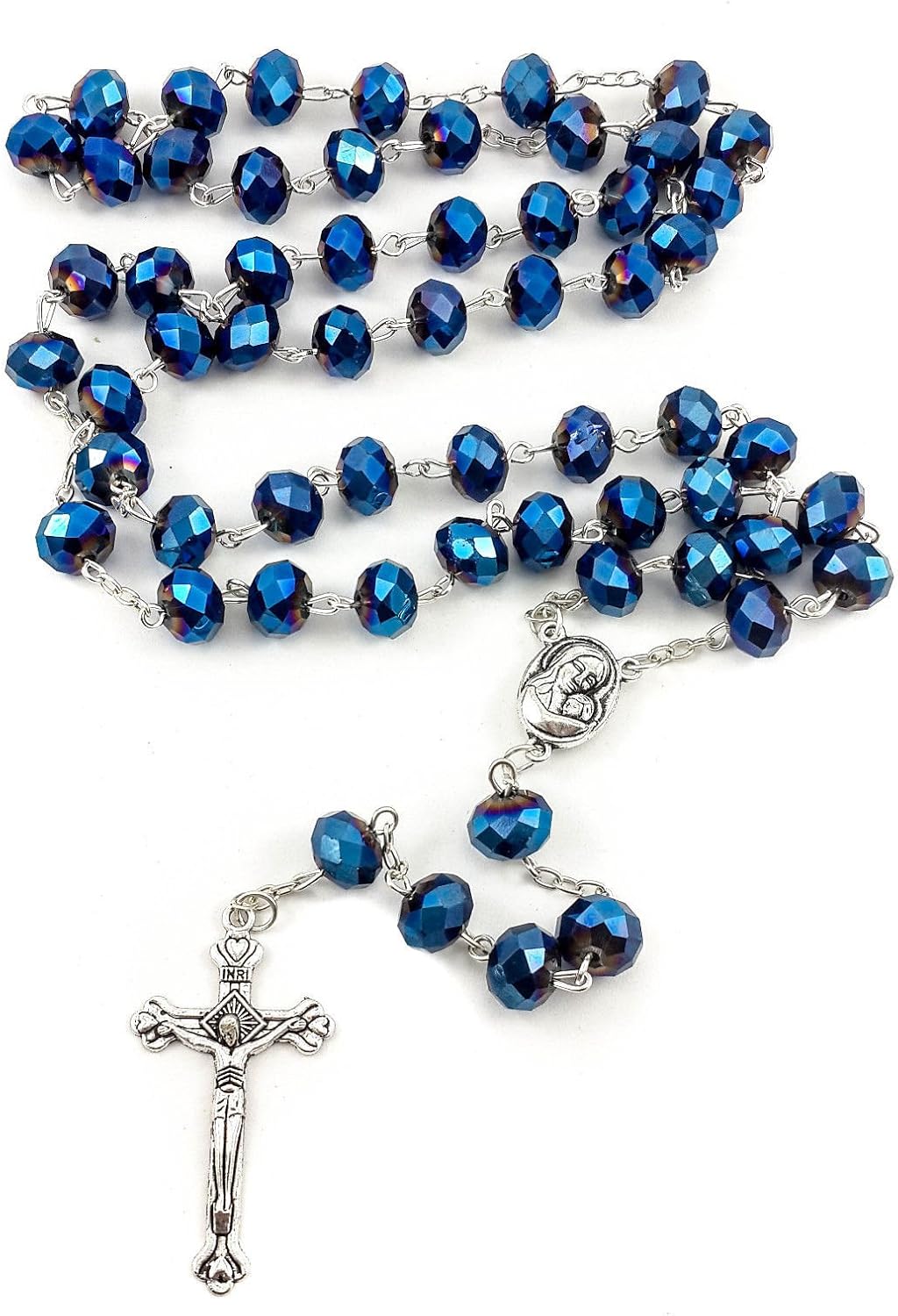
Common Protestant prayer bead designs include:
- Anglican-style rosaries with a repeated cycle of Scriptures or short prayers.
- Single-decade bead rings or bracelets for quiet, discreet prayer during the day.
- Simplified crosses with a few beads marking morning, midday, and evening prayer.
- Scripture-focused strands where each bead represents a specific Bible verse.
My own first experience with a more “Protestant-shaped” set of beads came during a Bible study that included both Catholics and Protestants. One of the hosts passed around a small bowl of wooden prayer beads and simply said, “If it helps you focus while we pray, you’re welcome to use these.” No one argued about theology that night. Some used the beads, some did not, but there was a deep sense of shared reverence.
That moment reminded me that the beads themselves are neutral; they do not replace Scripture, they do not replace faith, and they do not control God. They are more like a walking stick on a long hike—something you can hold to keep your steps steady.
How Protestant Believers Often Use Rosary Beads
The way Protestant Rosary Beads are used can be very flexible. Some believers prefer a fixed pattern; others simply move from bead to bead as they talk to the Lord. Both approaches can be honest and humble if they come from the heart.
Here are a few common ways Protestants may pray with beads:
- Scripture meditation: choosing one short Bible verse for the day and repeating it slowly on each bead, allowing the words to sink in.
- Intercessory prayer: assigning each bead (or group of beads) to a person or intention—family, friends, church, the world.
- Structured daily rhythm: using different sections of the beads for morning gratitude, midday petition, and evening examination of the day.
- Breath prayer: pairing a few simple words with inhaling and exhaling—like “Lord, have mercy” or “Jesus, I trust You”—and touching one bead with each breath.

I remember one winter when a close friend was ill and I felt powerless to help. I kept a small set of beads in my coat pocket. Whenever I reached a red light or stood in line at the grocery store, I would slip my fingers over a bead and whisper a very short prayer for her. It was not dramatic, and there was no strict schedule, but it kept her close to my heart before God throughout the day.
That is often how Protestant Rosary Beads quietly fit into life: they do not require a hidden chapel or a long block of time. They can simply rest in a pocket, on a nightstand, or by a favorite chair, gently inviting a moment of prayer whenever the day slows down for a second.
Choosing Protestant Rosary Beads With Simplicity And Care
Because prayer is so personal, the right set of Protestant Rosary Beads is less about appearance and more about whether they feel honest to you. There is no requirement to pick a certain material or color, but a few practical questions can help:
- Do the beads feel comfortable between your fingers—smooth enough, but not slippery?
- Is the cross or centerpiece simple and Christ-focused, without distracting details?
- Are the beads sturdy enough to be used often without worry?
- Does the style fit how and where you actually pray (at home, in church, while walking)?

For example, one of my own favorite sets is not particularly beautiful to anyone else. The cross is worn and the cord is a bit faded. But it has walked with me through hospital waiting rooms, late-night worries, and early-morning gratitude. When I pick it up, it quietly reminds me of God’s steady presence in those times.
Some Protestants prefer a very minimal design with no images at all—just beads and a plain cross—because it helps them focus on Scripture and on Christ alone. Others are comfortable with a slightly more traditional look. Both approaches can be faithful if they lead to deeper trust and attentiveness in prayer.
Protestant Rosary Beads In Family And Community Life
Protestant Rosary Beads can also have a quiet place within family life and small groups. They do not have to be the center of attention, and they certainly do not have to be used by everyone. But they can gently support shared prayer in simple ways.

In many homes and communities, prayer beads might be used to:
- Mark each person’s turn to share a prayer intention or a gratitude.
- Guide a short evening prayer with children, using one bead per simple phrase.
- Accompany a weekly Bible study, helping participants remember the passage of the week.
- Offer quiet comfort to someone going through grief or anxiety.
I once visited a Christian family where a small bowl of prayer beads sat near the front door. When friends came by and shared something heavy on their hearts, someone would sometimes pick up a bead, hold it for a moment in silence, and then place it back. There were no long speeches—just a gentle sign that the concern had been carried into prayer.
In that kind of setting, Protestant Rosary Beads are not a showpiece but a tool of quiet solidarity. Their presence on a table or hanging from a hook by the door can simply whisper, “Prayer belongs in this home.”
Respectful Differences And Shared Longing For God
As a Catholic who loves the traditional rosary, I also have deep respect for Protestant brothers and sisters who use their own forms of prayer beads. The patterns and meanings are not always the same, and that is all right. What matters most is that each person, and each community, seeks the Lord sincerely according to the light and understanding they have.
Over the years, I have prayed with friends from different Christian traditions—sometimes with a rosary in hand, sometimes with empty hands, sometimes with a Bible open on the table between us. What has stayed with me most is not the method, but the sense of shared hunger for God. In that light, Protestant Rosary Beads are simply one more way that some believers choose to quiet their minds and open their hearts.
If you are considering using them, it can be good to move slowly, to anchor every bead firmly in Scripture, and to remember that the real “power” is not in the beads, but in God’s faithfulness. The beads only help us show up with a little more attention and steadiness.
Living Prayer Simply, One Bead At A Time
In the end, Protestant Rosary Beads are not about building a collection or mastering a technique. They are about making prayer a little more tangible in the middle of ordinary life—between work emails, family meals, and late-night worries.

I have found that keeping even one small set of beads nearby—on my desk, in my pocket, or by my bed—gently reminds me that I can turn to God at any moment. I do not always respond to that reminder, but when I do, the beads help me stay with the prayer a little longer instead of drifting off after a few rushed words.
Whether you come from a Protestant background, a Catholic one, or a family that is still figuring things out, a strand of prayer beads can be a humble companion on the journey. They do not demand, they do not impress; they simply wait to be held during a psalm, a sigh, a wordless silence.

If you decide to welcome Protestant Rosary Beads into your own routine, you can let the practice grow slowly. Start with one verse, one short prayer, or even one deep breath on each bead. Let the beads become familiar friends rather than tools to “perform” prayer. In that simplicity, many believers quietly find room to listen a little more, trust a little more, and rest a little more in God’s presence.
FAQ About Protestant Rosary Beads
1. Are Protestant Rosary Beads the same as the Catholic rosary?
No. While they may look similar at first glance, Protestant Rosary Beads usually follow different patterns and are often centered more explicitly on selected Bible verses or simple Christ-focused prayers. The Catholic rosary has a very specific structure with decades of Hail Marys and particular mysteries. Protestant prayer beads are more flexible and can vary widely from church to church or person to person.
2. Do I need a pastor or priest to “bless” my Protestant Rosary Beads?
Many Protestants use prayer beads without any formal blessing at all, seeing them as a simple tool to support personal devotion. If you feel more at peace having a pastor pray with you over the beads, you can certainly ask, but it is not a requirement for the beads to be meaningful. What matters most is the prayer that happens while you use them, not a particular ceremony.
3. Can I create my own pattern of prayers for the beads?
Yes. One of the strengths of Protestant Rosary Beads is that many believers feel free to design a pattern that fits their faith tradition and their needs. You might choose a verse for each bead, or alternate between praise, confession, and petition. Some people keep a little notebook to remember the pattern they have chosen; others let it remain very simple and flexible.
4. Is it wrong to use beads if my church does not talk about them?
Every church community has its own emphases and customs. If your church does not mention prayer beads, it does not automatically mean they are discouraged; they may simply not be part of your congregation’s usual practice. If you are unsure, you can quietly speak with a trusted pastor or mature believer. In many cases, they will be more interested in the sincerity of your prayer than in whether you hold beads while you pray.
5. How can I start using Protestant Rosary Beads in a simple way?
A gentle way to begin is to choose one short Scripture verse—perhaps from the Gospels or the Psalms—and repeat it slowly as you touch each bead. Do this for just a few minutes, without forcing emotions or expectations. Over time, you can add more structure if you wish, or keep it as simple as this. The goal is not to “get through” the beads, but to give your heart space to be still before God.