
Praying Rosary Beads
Rosary beads are a simple way to keep the rhythm of prayer close at hand. They rest quietly in a pocket, on a nightstand, or around the wrist, waiting for those moments when the heart turns to God in trust, gratitude, or need. Over time, praying rosary beads can become as natural as breathing, a gentle path through the joys, sorrows, and ordinary routines of everyday life.
How praying rosary beads fits into daily Catholic life

For many Catholics in the United States, praying rosary beads is not something dramatic or extraordinary. It is usually quiet, often hidden, woven between work, family, and responsibilities. A rosary might be prayed in a car while waiting in a pickup line, on a short walk during lunch, or at the end of the day when the house finally grows still.
The beads themselves are simple tools that help the mind stay focused and the heart stay steady. Each bead is like a small step, keeping count so that we do not have to. This frees the mind to rest on the life of Christ and the loving presence of Mary, rather than on numbers or structure.
I still remember the first time I really noticed what my own rosary beads had become. The silver coating had worn off one decade from being held in the same spot during stressful days. I realized that every little chip and scratch came from real prayers: late-night worries for family, silent hopes at the doctor’s office, and many very imperfect Hail Marys whispered while half-distracted. That worn decade reminded me that God meets us in real life, not in some polished, perfect version of ourselves.
In that way, praying rosary beads does not require a special time or place, although those can help. It mostly asks for honesty and a little space in the heart. Some days the whole rosary flows easily. Other days, one decade is all that seems possible. Both can be offered to God with the same quiet trust.
Choosing rosary beads that suit your prayer
There is no single “right” style of rosary. Different materials and designs simply serve different kinds of daily life. Some people prefer a sturdy set of wooden beads that can handle a pocket, a backpack, or a glove compartment. Others are drawn to smooth glass or stone, which can feel calming in the hand. Metal chains, knotted cords, and flexible rope all have their own quiet strengths.
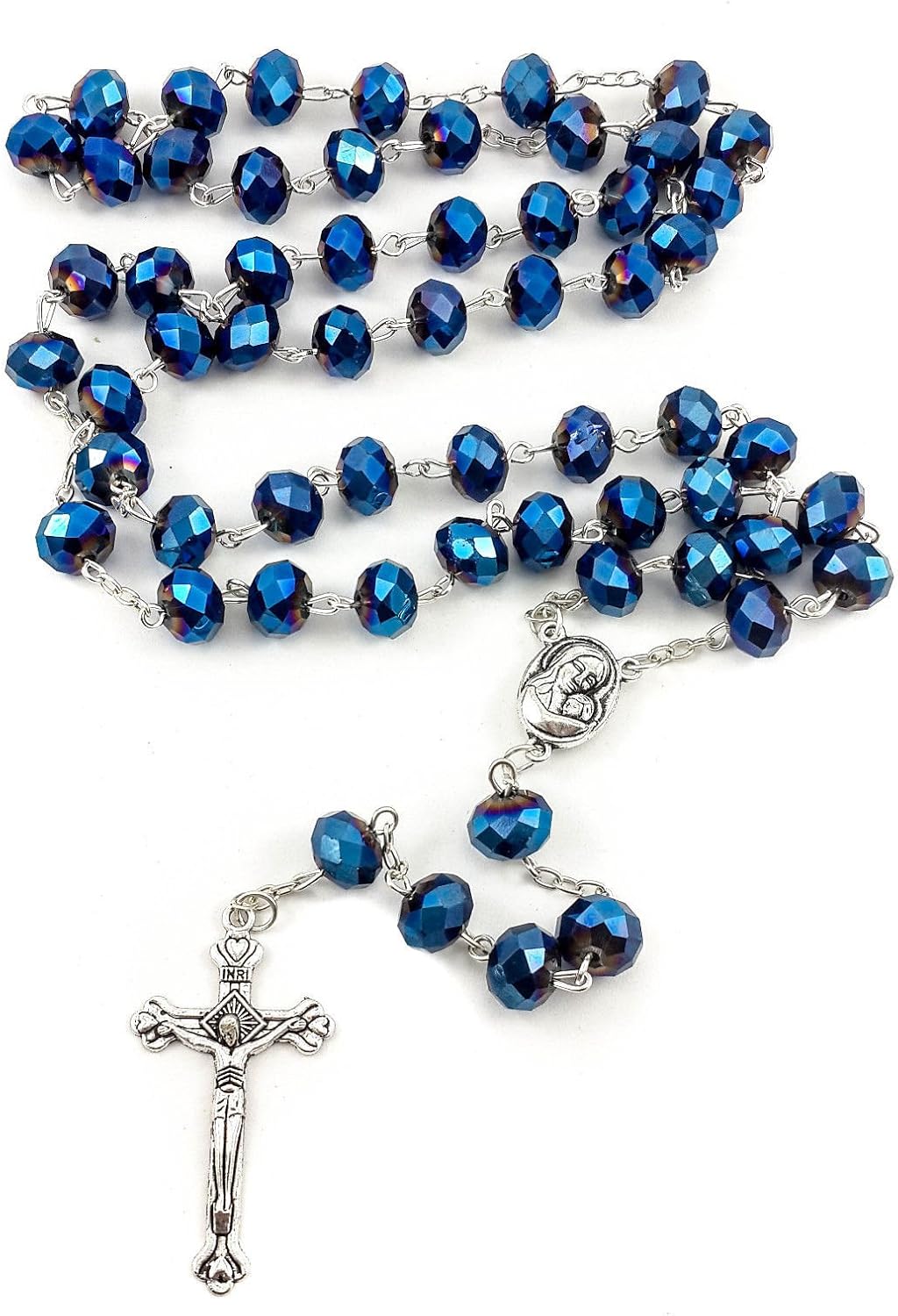
Over the years, I have used very different kinds of praying rosary beads. For a long time I kept a simple cord rosary in my car because it did not tangle or break easily. During a difficult season in my family, I carried a heavier metal rosary in my pocket. Its weight reminded me, in a small way, that I did not carry my worries alone. Now I tend to keep a lighter wooden rosary by my bedside, so that it is easy to pick up when I wake in the night.
When thinking about rosary beads for yourself or for someone else, you might quietly ask:
- Where will these beads usually be kept — by the bed, in a pocket, in a purse, on a desk?
- Do I prefer smooth, delicate beads or something more solid and rugged?
- Do I like the cool touch of metal or the warmth of wood or stone?
- Will these beads be used by children, teens, or adults?
- Is it helpful to have a crucifix and medal that are easy to see and hold?
These are not questions about fashion, but about making it easier to turn to prayer in ordinary circumstances. When the rosary fits our real life, we are more likely to reach for it not out of obligation, but because it feels familiar and close.
Simple ways to pray with rosary beads
There are many guides and booklets that explain the traditional structure of the Rosary. Those are helpful, especially when you are starting. But once you know the basic pattern, praying rosary beads can become very personal. The important thing is to stay turned toward God with honesty and humility, using the beads as a steady path.

Some people pray a full set of decades at once, maybe early in the morning with a cup of coffee before the rest of the house wakes up. Others pray a decade at a time throughout the day: one while walking the dog, one while waiting for an appointment, one before starting a hard task. By bedtime, the whole rosary has been offered, gently woven through the day.
I sometimes break my rosary into pieces during busy days. I might pray the first decade while driving to work, the next at lunch, another in the evening. It does not feel fancy or particularly holy. It simply keeps my heart turning back toward God during hours that might otherwise slip away in distraction.
Many Catholics also tuck special intentions into their praying rosary beads. One decade might be offered quietly for a sick relative, another for a struggling friend, another for the Church or for peace in the world. The beads help hold these concerns in one place, so that we are not overwhelmed by them but can hand them over as best we can.
Whether the rosary is prayed slowly and thoughtfully or in a more hurried way between tasks, it can still be sincere. Some days our minds wander. Some days our hearts feel dry. Even then, the physical motion of the fingers moving along the beads can be a way of saying, “Lord, I am here, even if I do not feel anything right now.”
Nighttime, worry, and praying rosary beads
Night can be a difficult time for many people. Worries tend to grow larger in the dark, and thoughts can circle around the same fears. Keeping rosary beads on a nightstand, under a pillow, or on a nearby shelf can offer a simple way to redirect those restless hours.

On nights when sleep does not come easily, I often reach for my rosary almost without thinking. Sometimes I start at the beginning and try to pray through all the mysteries. Other times I simply hold the crucifix and repeat a short prayer, or slowly move from bead to bead saying the name of Jesus in my heart. I usually do not finish before I fall asleep, but I have come to see that as part of the offering, not a failure.
The same can be true in times of grief or anxiety. We may not have many words to give. It may even feel hard to form complete thoughts. In those moments, the structure of the rosary stands beside us quietly, giving us a way to stay in prayer without forcing anything. The beads become almost like a hand to hold.
Keeping a set of rosary beads near the bed also makes it easier to begin or end the day in prayer, even if only with a single decade. Before turning on the phone or opening the laptop, a short time with the beads can gently set the tone for what follows.
Praying rosary beads together at home
Many American Catholic families have some kind of rosary tradition, even if it changes over the years. Some pray a full rosary together on certain evenings. Others might gather only for a decade, or for part of the mysteries on special feast days or during Lent and October. The important thing is not perfection, but the habit of turning to God together as a household.

When children are involved, simple is usually best. Shorter times of prayer, gentle explanations, and patience with restlessness can go a long way. Giving each child their own small set of praying rosary beads can help them feel included. They may not focus perfectly, but the feel of the beads in their hands can still plant quiet seeds of faith.
In my own experience, family rosary times have rarely looked like holy cards. There has been fidgeting, yawning, questions, and sometimes laughter at the wrong moments. But years later, I realized that what stayed with me was not the exact prayers, but the memory of everyone gathered with beads in hand, turning to God as best they could.
Some families keep a small basket or bowl near a family prayer corner, filled with different kinds of rosary beads. Each person can choose one at the beginning of prayer time. Over time, certain rosaries may become connected to particular memories: a first Holy Communion, a grandparent’s visit, a family pilgrimage or retreat.
Rosary beads in the car, at work, and on the go
Modern life often means long hours in cars, offices, schools, and waiting rooms. Praying rosary beads can quietly fit into these spaces without drawing much attention. A small set in the car can turn a commute into a time of intercession and gratitude. A pocket rosary at work can be a reminder to pause for a minute of prayer before a difficult meeting.
I have often kept a simple one-decade rosary clipped inside a work bag. I do not always use it, but just knowing it is there helps me remember that prayer can enter any part of the day. Sometimes, before opening my email or starting a big task, I will quietly hold the beads for a moment and ask for patience and wisdom. It does not change the workload, but it does change how I carry it.
Some people like bracelet rosaries, which make it easy to slip from regular life into prayer without fuss. Others prefer something that can be kept discreetly in a pocket. The exact style matters less than the simple fact that the beads are close at hand when the heart feels the need to turn toward God.
In seasons of heavy responsibilities, praying rosary beads can be broken up into very small pieces—sometimes even a single Hail Mary on one bead at a time. Even this little act, repeated through the day, can keep faith and daily life gently connected.
Rosary beads as quiet, meaningful gifts
Although rosary beads are not decorations or lucky objects, they often become meaningful gifts for important moments in Catholic life. Baptisms, First Communion, Confirmation, weddings, anniversaries, and times of illness are all moments when a rosary can quietly say, “You are not alone. I am praying with you and for you.”

When giving rosary beads, it can be a kind gesture to mention that you have already prayed with them, even briefly, for the person who will receive them. This helps the gift feel less like an object and more like a shared prayer. The person can then continue that prayer in their own way and at their own pace.
I once gave a simple set of wooden praying rosary beads to a friend who was going through a long period of uncertainty. There was nothing dramatic about it. I just slipped the rosary into a small pouch with a short handwritten note. Months later, my friend told me that the beads had become a quiet companion on hard nights, not because of anything I said, but because they gave a small, steady path to follow when words were hard to find.
Over time, gifted rosaries can become family heirlooms, passed down from one generation to another. The beads carry not only prayers, but also memories of the hands that once held them. In that way, they gently link the living with those who have gone before us in faith.
Taking care of your rosary beads
Because rosary beads are used regularly and often carried everywhere, they can wear over time. Chains may weaken, beads may loosen, cords may fray. This is natural and not something to fear. It can even be a reminder that prayer is part of real life, with all its limits and changes.

Still, it can be helpful to treat praying rosary beads with quiet respect. Some Catholics keep their rosary in a small pouch or case when not in use, especially if it is made of delicate materials. Wiping the beads gently with a soft cloth from time to time can keep them clean, especially if they are handled frequently.
When a rosary eventually breaks beyond repair, many people prefer not to throw it away casually. Some choose to bury or burn the pieces respectfully, or to bring them to a parish where they can be properly handled. This simple care reflects the fact that the rosary has been a companion in prayer, not just another object.
Whether brand new or very old, simple or ornate, every set of rosary beads is ultimately there for one purpose: to help the heart keep turning toward God in trust, repentance, and love, in good days and difficult ones, in clarity and in confusion alike.
Frequently asked questions about praying rosary beads
1. Do I need special praying rosary beads to start?
No. Any simple, complete rosary can be used. Some people begin with a very basic plastic or cord rosary and later find other styles that suit them better. What matters most is the intention of the heart, not the cost or appearance of the beads. If you already have a rosary at home, you can start with that. If you are looking for one, you might choose something that feels comfortable in your hand and fits your daily routine.
2. What if I get distracted while praying the rosary?
Distractions are normal. Most people experience wandering thoughts, especially when they are tired or worried. When this happens, you can simply notice the distraction and gently return to the next bead and the next prayer. The beads help you pick up where you left off without feeling lost. God understands our limits and receives even imperfect prayer offered with sincerity.
3. Is it alright to pray just part of the rosary?
Yes. Many Catholics pray a decade at a time when a full rosary is not possible. A single decade can be offered for a particular intention or as a way to begin or end the day. Over time, you might find that some days allow for more, others for less. There is no need to force a particular length; what matters is that you make room, however small, for prayer in your life.
4. Can children use praying rosary beads?
Children can certainly use rosary beads, though their way of praying will naturally be simpler and shorter. Many families introduce children to the rosary with one-decade chaplets or colorful, sturdy beads that can handle rough handling. It is usually best not to expect perfect stillness or understanding. Over time, the gentle repetition and physical touch of the beads can become familiar and comforting to them.
5. How can I keep my rosary from being forgotten in a drawer?
Small habits can help. You might keep your praying rosary beads in a place you naturally see every day: on your nightstand, near your keys, next to your favorite chair, or in your car’s console. Some people link the rosary to regular activities—like a daily walk, a commute, or a short break at lunchtime. When the beads are visible and close at hand, it becomes easier to reach for them without making a big decision each time.